
Earn your instrument rating.
A cloud layer over Dallas Fort Worth should not cancel your trip. The instrument rating is what lets you file, climb through it and fly the approach at the other end.

A private certificate gets you flying on good days. An instrument rating gets you there on the days you actually have somewhere to be, and it makes you a sharper pilot on the clear ones too.

A panel you will want to fly.
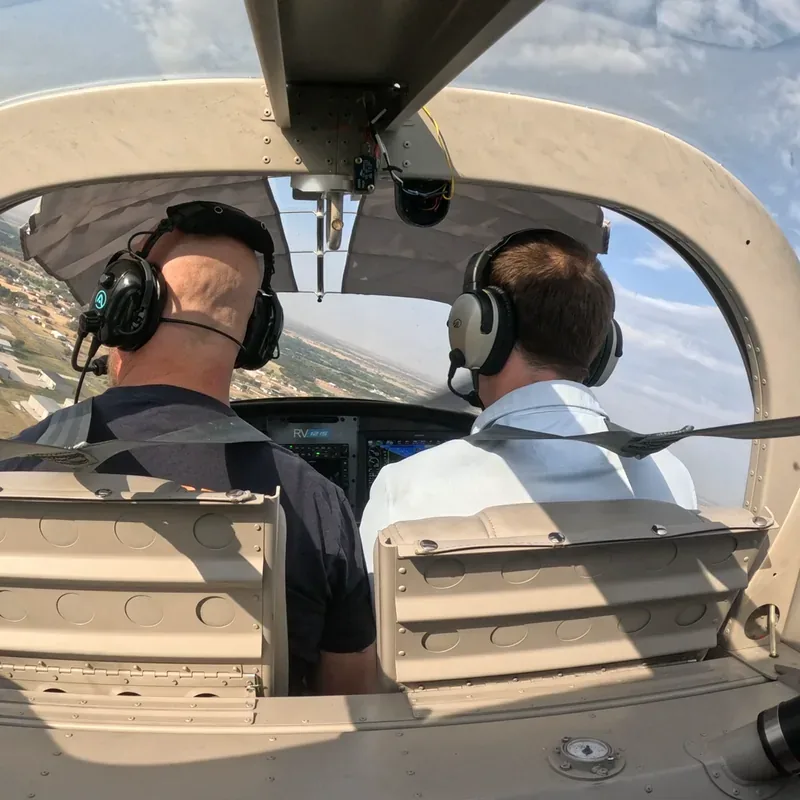
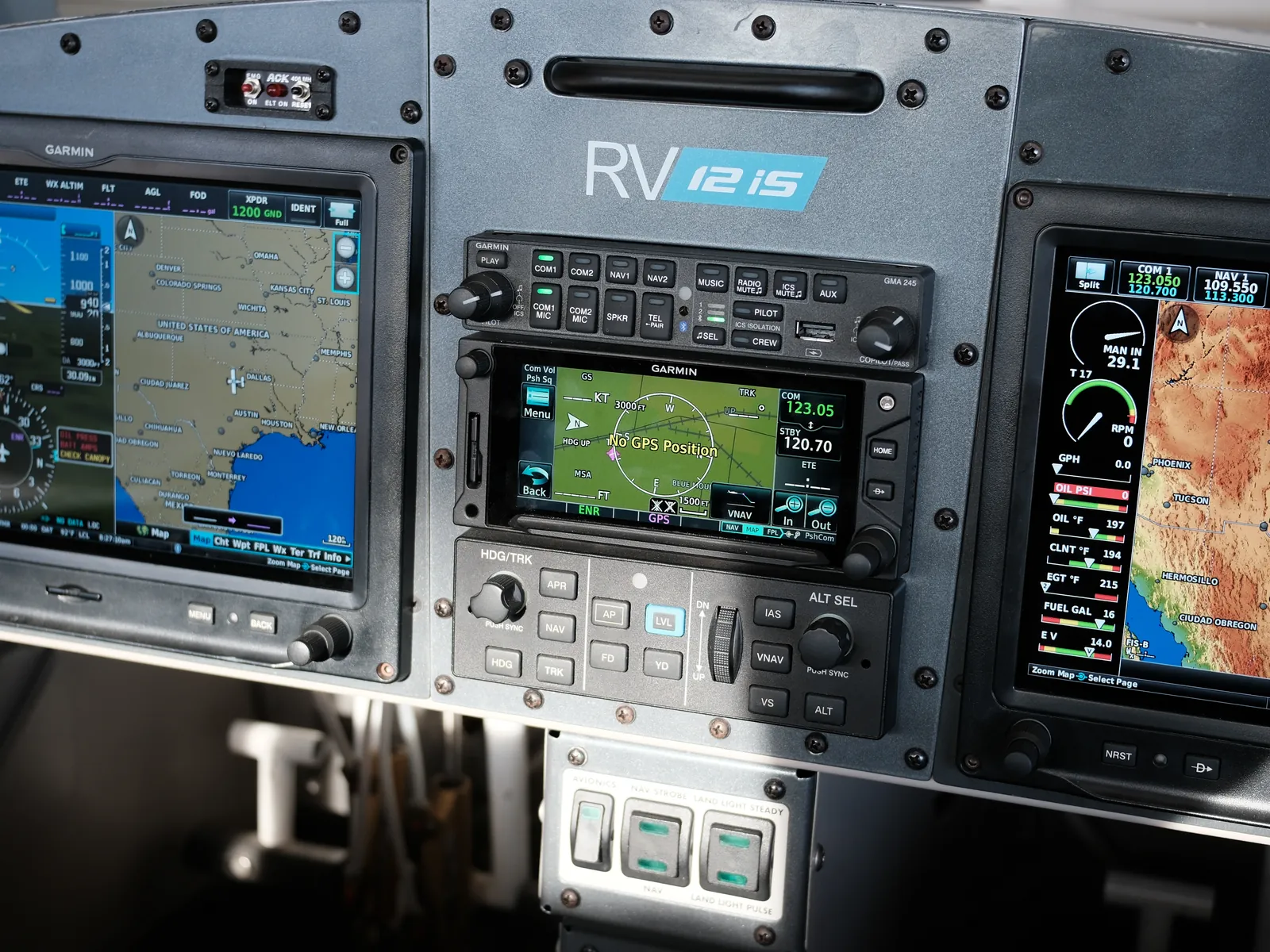
Instrument training happens in N903S, a 2023 Van's RV-12iS equipped for instrument flight. Two Garmin G3X Touch screens, a Garmin GTN 650 navigator and an autopilot, the same kind of glass and GPS you will find in a lot of owner airplanes. Its sister ship N492VT carries the same IFR panel, so a maintenance day does not stop your training.
- Dual Garmin G3X Touch
- Garmin GTN 650
- Garmin autopilot
- ADS-B In and Out
- $165/hr wet
How does instrument training work?
Flying, approaches and ground study run side by side. Part 61 means there is no fixed syllabus clock, so it fits around your calendar.
Check the logbook against 61.65.
One sitting to count your cross-country and instrument time. Hood time from your private training counts toward the 40 hours, and any cross-country gap gets planned early so it never holds up the checkride.
Fly by reference to instruments.
Attitude flying, partial panel, unusual attitude recovery. Holding altitude, heading and airspeed to tight tolerances until it stops taking all your attention.
Learn the system.
Clearances, departures, holds, and the ILS, RNAV and VOR approaches, flown with real approach controllers in Dallas Fort Worth airspace, not in a quiet practice area.
Pass the knowledge test.
The FAA instrument written, taken early so it is not hanging over you. 70 percent to pass, good for 24 calendar months.
Fly the long IFR cross-country.
At least 250 nautical miles under instrument flight rules, an approach at every airport, three different kinds of approaches. This is the flight where the pieces come together.
Polish to standard, then the checkride.
Three hours of prep in the last two calendar months, an endorsement, then the oral and the flight with an FAA examiner.
Brief every approach out loud, at your kitchen table.
Pull up the approach plate, say the frequencies, courses, altitudes and the missed approach out loud, and touch where each switch would be. Pilots who chair fly approaches before the lesson spend their airplane time flying, not reading.
What does the FAA require for an instrument rating?
If you have been flying cross-country since your private checkride, a good part of this may already be in your logbook.
- A private pilot certificate or better
- Read, speak, write and understand English
- 50 hours cross-country as pilot in commandAt least 10 in airplanes
- 40 hours actual or simulated instrument timeIncluding 15 hours of instrument training from an authorized instructor
- 3 hours of instrument training within 2 calendar months of the checkride
- A 250 nm cross-country under IFRAn approach at each airport, three different kinds of approaches
- The FAA instrument knowledge test
- The practical test with an FAA examiner
When do you need an IPC?
Already instrument rated but out of practice? This is how currency works under 14 CFR 61.57, and where an instrument proficiency check fits.
- 1
Current.
Six approaches, holding, and intercepting and tracking courses in the last 6 calendar months. You can file and fly IFR.
- 2
Lapsed, months 7 to 12.
You cannot file, but you can catch up the six approaches and the holds with a safety pilot or an instructor.
- 3
Past 12 months.
Only an instrument proficiency check gets you current again. Catching up approaches on your own no longer counts.
- 4
The IPC.
A ground session, then the tasks from the Instrument Rating ACS: clearances, holds, approaches, a missed approach and emergencies, flown in N903S.
- 5
Endorsement.
When you fly it to the standard, I endorse your logbook and your 6 month clock starts over. It is a check, not a checkride.
Need your 24 month flight review at the same time? Tell me when you call and we will plan the two together.
How much does an instrument rating cost?
The total depends on what is already in your logbook, so I will run the numbers with you on the phone. The rates are fixed and you pay for the time you use. Flying at least twice a week keeps the total down, because instrument skills fade fast between lessons.
Still working on your private certificate? Start with private pilot training. Instrument rated and close to 250 hours? The next step is commercial pilot training. Flying from the Fort Worth side? See flight lessons at Hicks Airfield.
Common questions.
The things people ask before their first call. If yours is not here, ask me directly.
How do I get an instrument rating in Dallas Fort Worth?
You start with a private pilot certificate, then train toward the FAA instrument rating under 14 CFR 61.65. With Settle Aviation that training is one-on-one with Sam Settle, a private flight instructor flying out of Hicks Airfield (T67) in Fort Worth and Aero Valley (52F) in Roanoke, in N903S, a 2023 Van's RV-12iS equipped for instrument flight with dual Garmin G3X Touch displays, a Garmin GTN 650 navigator and an autopilot. The work runs in three parts at once: flying by reference to instruments, learning approaches, holds and clearances in real Dallas Fort Worth airspace, and studying for the FAA instrument knowledge test. When your logbook shows the required experience and you fly to the Instrument Rating Airman Certification Standards, you get an endorsement for the checkride with an FAA examiner. Part 61 means there is no fixed syllabus clock, so the schedule fits around your work instead of the other way around.
What are the FAA requirements for an instrument rating?
For an airplane instrument rating, 14 CFR 61.65 asks that you hold at least a private pilot certificate and can read, speak, write and understand English. You need 50 hours of cross-country flight time as pilot in command, with at least 10 of those hours in airplanes. You need 40 hours of actual or simulated instrument time, including 15 hours of instrument flight training from an authorized instructor, and 3 hours of instrument training within the 2 calendar months before the checkride. You also need one cross-country flight under instrument flight rules of at least 250 nautical miles, with an instrument approach at each airport and three different kinds of approaches. Finally, you pass the FAA instrument knowledge test, which needs a score of 70 percent and stays valid for 24 calendar months, and then the practical test with an examiner. The hood time from your private pilot training counts toward the 40 hours.
How much does an instrument rating cost in the DFW area?
The total depends on how many hours you already have, mostly your cross-country time and any instrument time already in your logbook, so the honest answer starts with your logbook rather than a package price. The rates themselves are fixed and published. Flight instruction is 75 dollars an hour, ground instruction is 50 dollars an hour, and N903S, the IFR-equipped 2023 Van's RV-12iS, is 165 dollars an hour wet, with fuel included. Briefing before each flight and debriefing after it are billed as ground time at the same 50 dollar rate, so you always know what each lesson is made of. The FAA knowledge test is paid to the testing center and the checkride is paid to the FAA examiner, both directly. There are no packages, deposits or block purchases. Call with your logbook totals and Sam will tell you what is left and what it should cost.
What is an instrument proficiency check (IPC)?
An instrument proficiency check, or IPC, is how an instrument rated pilot gets instrument currency back after letting it lapse. Under 14 CFR 61.57(c), to file and fly under instrument flight rules you must have logged, within the preceding 6 calendar months, six instrument approaches, holding procedures and tasks, and intercepting and tracking courses with navigation systems. If you miss that window you have another 6 calendar months to catch up with a safety pilot or an instructor. Once a full year has passed, 14 CFR 61.57(d) requires an IPC with an authorized instructor or examiner. The IPC follows the tasks the FAA lists for it in the Instrument Rating Airman Certification Standards: air traffic control clearances and procedures, flight by reference to instruments, navigation systems, approaches, missed approaches and emergency operations. It is not a checkride. Settle Aviation flies IPCs in N903S, with a ground session first.
Why train for an instrument rating as a business owner?
An instrument rating is what turns a private certificate into a way to actually travel. Without it, a low cloud layer over Dallas Fort Worth on the morning of a meeting cancels the trip, and a forecast that turns on the way home leaves you sitting at an FBO waiting it out. With it, you can file, climb through the layer and fly the approach at the other end, inside the weather minimums the rating allows. Most owners who fly for business find the rating changes how often they can use the airplane far more than any upgrade to the airplane itself. Instrument training also makes you a more precise pilot in clear weather, because you learn to hold altitude, heading and airspeed to tight tolerances and to manage the radios and the navigator without falling behind. It is also the usual next step before commercial training, since 14 CFR 61.133 limits a commercial pilot without one.